
Rising employment costs, permits and retirement rules

Rising employment costs, permits and retirement rules in 2026
Recruitment plans are holding steady, with nine in ten businesses keeping or growing headcount, according to our 2026 Food and Agribusiness Report. Cost is this year's main pressure point, rising employment costs and salary expectations top the list of challenges, with employment permit thresholds and new retirement legislation adding further pressure.
Nine in ten businesses are maintaining or growing their workforce with 38% of agrifood businesses planning to employ more people over the next 12 months. At the same time, 62% do not expect to increase headcount. For those businesses, growth will depend more heavily on getting greater capacity from the existing workforce, alongside technology and other productivity improvements. That puts greater emphasis on retention, training and how work is organised.

Mary McDonagh, Head of HR & Payroll Services
The cost of employment
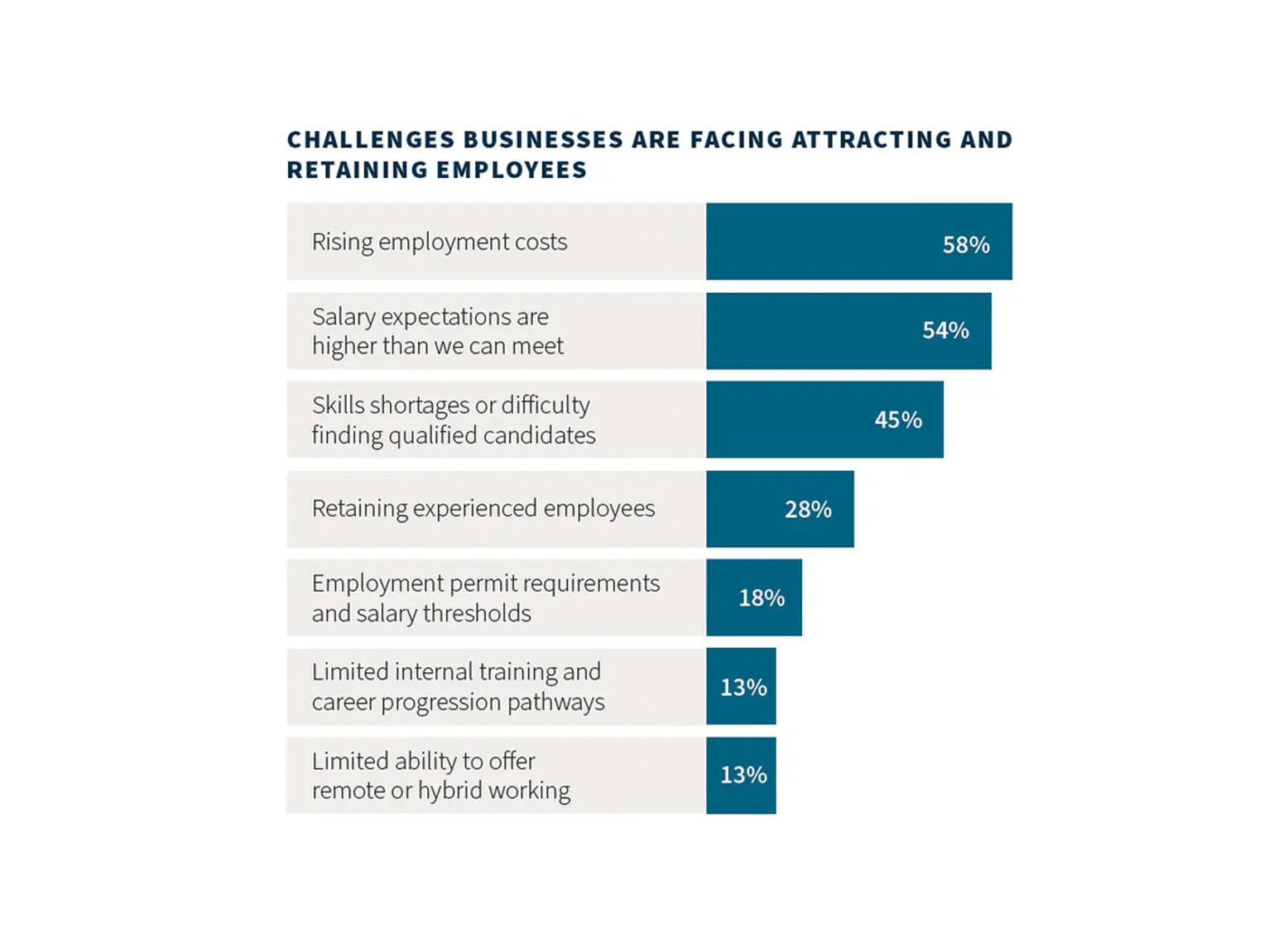
Rising employment costs are the most cited challenge at 58%, followed by salary expectations at 54%. Salary expectations remain a significant challenge, although fewer businesses cite them this year than in 2025. Skills shortages have not eased in the same way, cited by 45% as a real challenge. Only 13% identify limited remote or hybrid working as a recruitment and retention challenge, reflecting the predominantly on-site nature of food and agribusiness operations.
For certain roles much of this increase in costs is set by legislation rather than negotiated with employees.
The national minimum wage rose 4.8% to €14.15 per hour from 1 January 2026, with the Government committed to a national living wage set at 60% of median earnings, targeted for 2029.
Auto-enrolment (My Future Fund) commenced on 1 January 2026, with an employer contribution starting at 1.5% of gross pay and rising in stages to 6% over the following decade.
Employer Pay Related Social Insurance (PRSI) increases by a further 0.15 percentage points from 1 October 2026, following the 0.1 point increase in October 2025..
Managing employment costs
For a business with 25 employees on an average salary of €40,000, auto-enrolment and the October PRSI change together add between 1.2% and 1.7% to payroll cost, depending on how many employees are already in a qualifying pension scheme. Auto-enrolment contributions rise in stages from 1.5% to 6%, so that element alone will quadruple over the next decade on the same payroll.
Practical steps to take now:
1 Model three years, not one.
Build the scheduled minimum wage, PRSI and auto-enrolment increases into a single three-year view of payroll cost and bring that figure into customer pricing discussions rather than absorbing each increase as it arises.
2 Check the employer PRSI threshold.
The lower rate applies only up to €552 per week. A single hour of weekly overtime can add over €640 a year in employer PRSI. Review rosters and overtime patterns against this threshold.
3 Decide on your pension approach.
Auto-enrolment is calculated on total pay, including overtime and bonuses, and gives no tax relief on employee contributions. An occupational scheme or PRSA meeting the minimum standard (combined contributions of at least 3.5% of gross pay or €2,800 a year, whichever is lower) is usually based on basic pay only, exempts staff from auto-enrolment, and restores that tax relief. Many businesses use a mix of both.
4 Use cost-efficient reward.
The Small Benefit Exemption allows up to €1,500 per year tax-free across up to five separate benefits until the end of 2029, though the benefits must be non-cash, such as vouchers, rather than cash payments. Employers can also offer non-pay benefits such as extra annual leave, early Friday finishes during quieter months, or flexible start times where possible.
Employment permits
From 1 March 2026, the minimum salary threshold for a General Employment Permit increased from €34,000 to €36,605. Under the Government’s Employment Permits Remuneration Roadmap, salary thresholds will continue to be reviewed annually. Half of businesses surveyed (49%) agree or strongly agree that annual threshold increases will make recruitment and retention more difficult. Excluding the 19% for whom permits are not relevant, agreement rises to 60%. Only 6% disagree. Concern about future threshold increases is considerably higher than the proportion currently identifying permit requirements as a recruitment challenge, at 18%. One possible concern is that higher permit thresholds may also influence wider salary expectations, not only the pay of permit holders.
Key points for employers:
1 Renewals carry the cost.
An existing permit holder on €34,000 must be brought to €36,605 in order to renew. Budget for renewals at current thresholds, not at the salary originally agreed.
2 Sector thresholds are closing.
For meat processors and horticultural workers, the minimum rose from €30,000 to €32,691 and these lower thresholds will be phased out entirely by 2030.
3 Check working hours.
Thresholds are based on a 39-hour week. Where employees work more than 39 hours, each additional hour must be paid at a minimum of €18.05.
4 Graduate thresholds have returned.
Lower thresholds now apply to recent graduates, offering a more accessible entry route for early career hires.
5 Plan the full timeline.
The role must first be advertised for 28 days under the Labour Market Needs Test and the application must then reach the Department of Enterprise, Tourism and Employment (DETE) at least 12 weeks before the intended start date. Visa-required nationals then need a visa application and, on arrival, an Irish Residence Permit. From decision to first day is commonly four to six months, so check DETE’s current processing dates before committing to a start date.